> For the complete documentation index, see [llms.txt](https://docs.mayaprotocol.com/llms.txt). Markdown versions of documentation pages are available by appending `.md` to page URLs; this page is available as [Markdown](https://docs.mayaprotocol.com/archive/liquidity-auction.md).
# Liquidity Auction
**What is the Maya Liquidity Auction?**
A Liquidity Auction is a fair launch combined with an airdrop. Users may provide external assets and are airdropped $CACAO proportional to their contribution. LP their tokens and get matched amounts with the offered token, in this case, $CACAO. The process will help us bootstrap the initial liquidity that the protocol needs to function and provide a superior user experience to our swappers with less slippage for swaps. Tier 1 participants will also get an allocation of $Maya tokens. [Read more](https://mayaprotocol.gitbook.io/whitepaper/readme/fair-launch) in our Whitepaper.
**Can I buy $CACAO after the Liquidity Auction?**
Remember, there will not be any other $CACAO issuances, so anybody that wants to own the token will have to acquire it from somebody that got it during this mint.
$CACAO’s price will likely be the cheapest ever (in $BTC terms) right after the auction. This makes it more attractive for people to invest heavily during the Liquidity Auction.
**When is the Maya Liquidity Auction?**
Maya Liquidity Auction started on March 16th, 2023 and ended on April 1st.
**What assets were used to provide Liquidity?**
Anybody could contribute supported assets, such as $BTC, $ETH, $USDT, $USDC and $RUNE, to the auction during the timeframe by sending them to a specified address.
**Was there a minimum entry?**
No, anyone could participate with as little as one satoshi! Excluding transaction fees of course.
There was also a $MAYA token airdrop for early liquidity providers and $RUNE holders.
**Could users withdraw during the Liquidity Auction?**
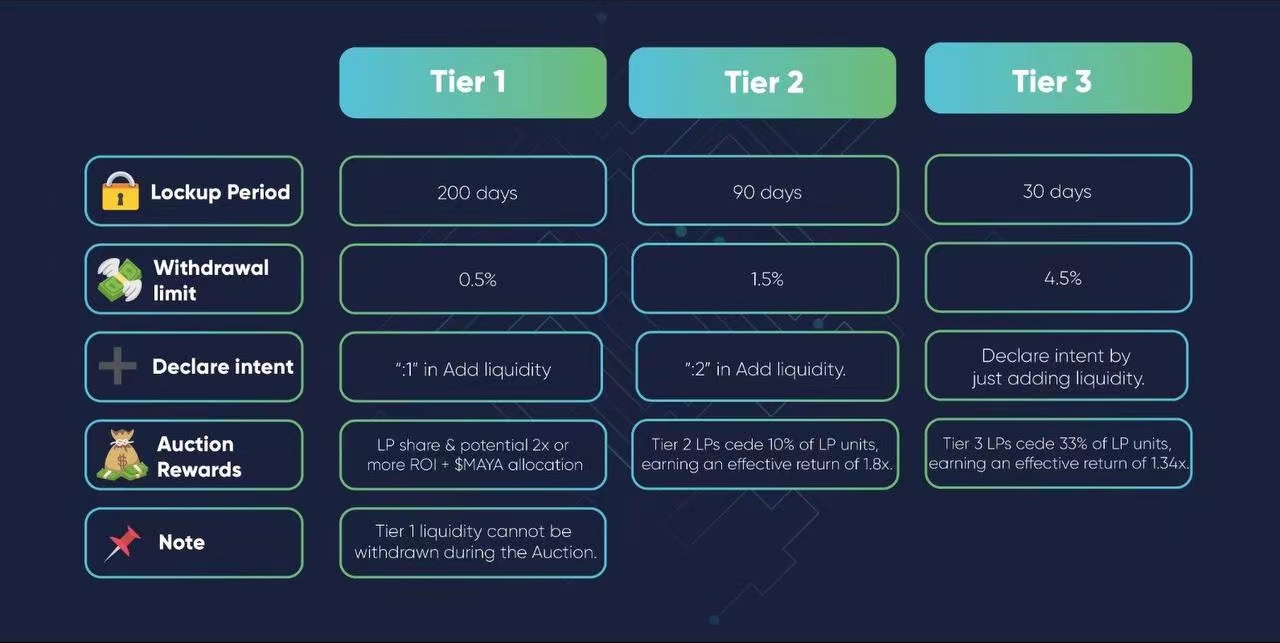
Withdrawals during the Liquidity Auction period (21 days) were only allowed for Tier 2 & Tier 3 LPs without any limits. They can exit at any point if they no longer want to participate in the auction. Tier 1 LPs are our most committed LPS. Therefore withdrawals were not allowed during the Liquidity Auction period.
**Could I withdraw my assets after the Liquidity Auction ends?**
Once the LA ends, participants will receive their $CACAO. Maya designed a Liquidity Auction Withdrawals Tiers model to prevent rapid withdrawals and $CACAO dumping. Each Tier has a different lock-up period and daily withdrawal limit.
**What safety precautions were taken during the auction?**
We’ve undergone thorough audits with [HalbornSecurity](https://halborn.com/) to ensure no vulnerabilities were found. We will also ran bug bounties on.
---
# Agent Instructions
This documentation is published with GitBook. GitBook is the documentation platform designed so that both humans and AI agents can read, navigate, and reason over technical content effectively. Learn more at gitbook.com.
## Querying This Documentation
If you need additional information that is not directly available in this page, you can query the documentation by asking a question.
Perform an HTTP GET request on the following URL with the `ask` and `goal` query parameters:
```
GET https://docs.mayaprotocol.com/archive/liquidity-auction.md?ask=&goal=
```
`ask` is the immediate question: it should be specific, self-contained, and written in natural language.
`goal` is what the user is ultimately trying to achieve, the reason they need the answer. Sharing it helps GitBook give you a better, more relevant answer. A goal is most helpful when it describes the outcome the user wants rather than restating the question. For example, with `ask=how do I create an API token`, a goal like `automate deployments from our CI pipeline` lets GitBook tailor the answer to that use case.
The response will contain a direct answer to the question and relevant excerpts and sources from the documentation.
Use this mechanism when the answer is not explicitly present in the current page, you need clarification or additional context, or you want to retrieve related documentation sections.